

The Scoville Heat Unit (SHU) is a measurement used to quantify the spiciness or heat of chili peppers and other spicy foods. It is named after its creator, American pharmacist Wilbur Scoville, who developed the Scoville Organoleptic Test in 1912. The SHU indicates the amount of capsaicin, the chemical compound responsible for the heat sensation, present in the pepper. Capsaicin stimulates nerve endings in the skin, especially the mucous membranes, and the SHU scale helps in comparing the capsaicin concentration across different types of peppers.
To determine the SHU, a solution of the pepper extract is diluted in sugar water and given to a panel of tasters until the heat is no longer detectable. The level of dilution needed to reach this point gives the pepper its SHU rating. For example, a bell pepper, which contains no capsaicin, has a SHU of zero, whereas the extremely hot Carolina Reaper can measure up to 2.2 million SHU. This method, while effective, is subjective as it relies on human taste testers, and modern techniques like high-performance liquid chromatography (HPLC) are now often used for more objective and precise measurements.
The Scoville scale is widely used not only by consumers to gauge the heat of different peppers and spicy products but also by food manufacturers and researchers. It plays a crucial role in culinary arts, agriculture, and food science. The knowledge of SHU helps chefs create balanced dishes, assists farmers in cultivating peppers with desired heat levels, and enables scientists to study the effects of capsaicin on health and its potential uses in medicine. Despite its age, the Scoville scale remains a fundamental tool in the world of spices and heat.
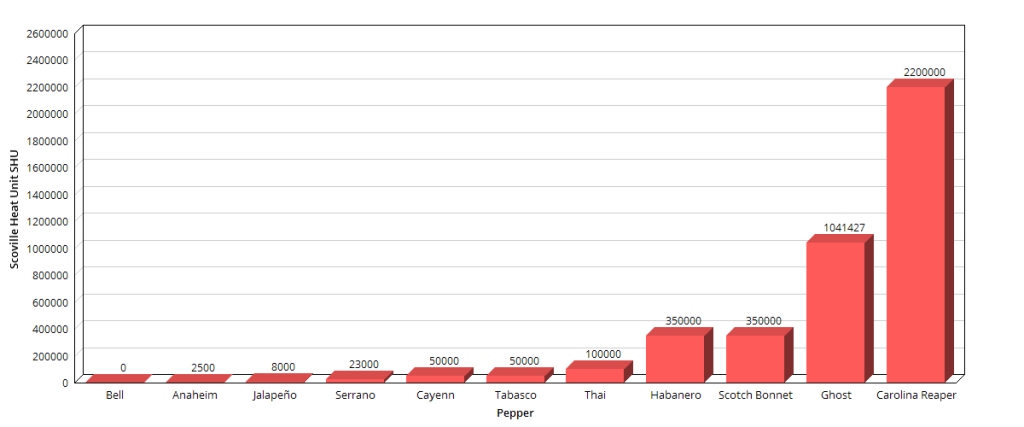
In summary:
Origin: The Scoville heat scale was developed by American pharmacist Wilbur Scoville in 1912. It was originally a method to measure the heat of chili peppers.
SHU (Scoville Heat Units): The scale is measured in Scoville Heat Units (SHU), which indicate the amount of capsaicin present in a pepper. Capsaicin is the chemical compound responsible for the spicy sensation.
Testing Method: Scoville’s original method, called the Scoville Organoleptic Test, involved diluting a pepper extract in sugar water until a panel of tasters could no longer detect the heat. The degree of dilution gave the pepper its SHU rating.
Modern Methods: Today, High-Performance Liquid Chromatography (HPLC) is used for a more accurate and objective measurement of capsaicin content in peppers, though results are often still converted to SHU for consistency with the traditional scale.
Range of the Scale: The Scoville scale ranges from 0 SHU, which is the rating for bell peppers (no heat), to over 2 million SHU, which is where some of the world’s hottest peppers, like the Carolina Reaper, fall.
Not Just Peppers: While primarily used for chili peppers, the Scoville scale can also be applied to other spicy foods, including hot sauces and even certain spices.
Pepper Examples:
- Bell Pepper: 0 SHU
- Jalapeño: 2,500 to 8,000 SHU
- Habanero: 100,000 to 350,000 SHU
- Carolina Reaper: 1,400,000 to 2,200,000 SHU
Health Benefits: Capsaicin, the compound measured by the Scoville scale, has been found to have health benefits, such as pain relief, reduced inflammation, and even aiding in weight loss by boosting metabolism.
Tolerance: People’s tolerance to heat varies widely, and frequent consumption of spicy foods can increase one’s tolerance to higher SHU levels.
)